An Interview with CorgiSpace Dev Adam Saltsman

Creating CorgiSpace
For this month’s newsletter, Finji Co-founder and Director Adam Saltsman chatted with Community & Social Media Manager Aster Wright about CorgiSpace, his new collection of 8-bit games that have short legs on purpose! Discover how and why Adam made more than a dozen games for the collection in his limited free time this year, his process for designing small games, and more!
ASTER- You made the CorgiSpace games in your (already limited) free time while working full-time on Usual June. WHY? What motivated that?
ADAM- When I started, I wasn’t trying to make a bunch of games or even this philosophy joke or anything, I just wanted to make a little game to go with my friend Kyle’s new dungeon synth album. So, in a way, the motivation was “this album is cool, it’s fun to think about a game that would go with this.” But, I had a blast making it, and I kind of started on a second game before I even got the first one done. So the most direct motivation was to amuse myself (and to a lesser degree to amuse Kyle.
Over a year in though, I do think there was a jumble of other things going on. One thing is I was feeling some pressure to know game design better or deeper. John Gardner, or someone like that, used to say that if you want to get better at writing, you should write some short stories, only write a few pages or whatever, to start, but really think about the words you’re picking and why. Don’t worry about quantity at all at first, worry about quality and think deeply about what each word accomplishes in a sentence. I missed making small games really badly anyway, so I thought, “oh maybe that would be fun to return to, and maybe it could be a way to understand game design better.” Basically, make some “short story” equivalent of games, and really think about each of the “words” I was using in them. Not in a hard, struggle way, but in a “these are fun to think about” way.
Because the idea was never “do a bunch of miserable homework and hope I learn something at the end,” it was always some version of “really genuinely enjoy myself, making funny weird interesting little things again.” And a part of that, for me, will always be the very real fun of getting a better or deeper sense of how my favorite art form does work or could work or has worked or whatever. And then that feeds back into the game-making, which feeds back into learning more about games, and so on. This loop is deeply thrilling for me. But mostly I wanted to amuse myself! And I have.
ASTER- What was your game design process? What was your workflow like?
ADAM- All of these games start with a little 30-60 minute session where I try to get the very first thing of it working, and only that, and then play it and see what I notice. For example, for what eventually became Sebastian’s Quest, I noticed the player movement code for one of my previous games could do a block-pushing mechanic really easily. So I spent maybe 20 minutes getting that working, and then I just played around in the little sandbox level I had set up. I wasn’t testing it, though. It’s more like shaking a Christmas present to try to guess what’s inside. Like what’s in this thing? When I was playing my sandbox level, I kept getting stuck, and noticing that I wanted to just—cheat, basically. Just erase a wall. As a player, I wanted to be more like the game designer, I wanted to change the level and help create the space in which the puzzle could be solved.
That would be a really easy ability to add, and most block-pushing games don’t let you do that, since it would undermine the whole idea of that kind of level design or puzzle design. So that seemed like a funny thing to try, and it was! Yes, it totally undermined the whole idea of level design, but, I noticed that if you could only erase a few blocks, if that ability was limited, well, that didn’t undermine anything. That actually set up a whole new kind of level design you could do. I think this happens a lot when something is “easy but not obvious!”
After I implemented it, it felt like you were eating the walls, like Pac Man or something, more than erasing them. That reminded me of our first pug Sebastian, because he used to eat the walls in our second apartment, too. So then the main character became a pug, and the resource you use to erase walls got called “APPETITE,” and so on. This is how it goes! I have not been able to finish even one of these without letting go of the reins for big chunks of the process. These insights or whatever usually only come out a little bit at a time, spread out over a few short sessions over a few days or weeks, with lots of time to think about what weird little thing to try next.
ASTER- You’ve talked about the importance of letting “fun” be a guide for you. What does that mean for you? How does that work as a game design pillar? As a guide for creative work in general?
ADAM- So much game design advice, and creative advice in general, is about making sure your output is something someone else will enjoy, and so little advice is about making sure you enjoy it, that you are enjoying yourself while you make the thing, that the making itself is enjoyable. It’s funny to me, because in order to actually finish a thing, in order to stay engaged with it, if you want to dig into it enough to find the thing that might make it really special, you have to be enjoying yourself! You have to feel confident that at least one person will love this thing when it’s done, and it’s usually easiest if that one person is you. And you can’t suddenly start loving your game just because it got “done enough” or “good enough” after being indifferent to it for most of development. That’s Stockholm syndrome, not love. You have to love it from the start, and that’s so hard to do when you’re not enjoying yourself.
Want to learn more about Adam’s CorgiSpace philosophy? Check out this YouTube playlist! You can also join us for CorgiJam, a game jam about making games that are SUPPOSED to be small!
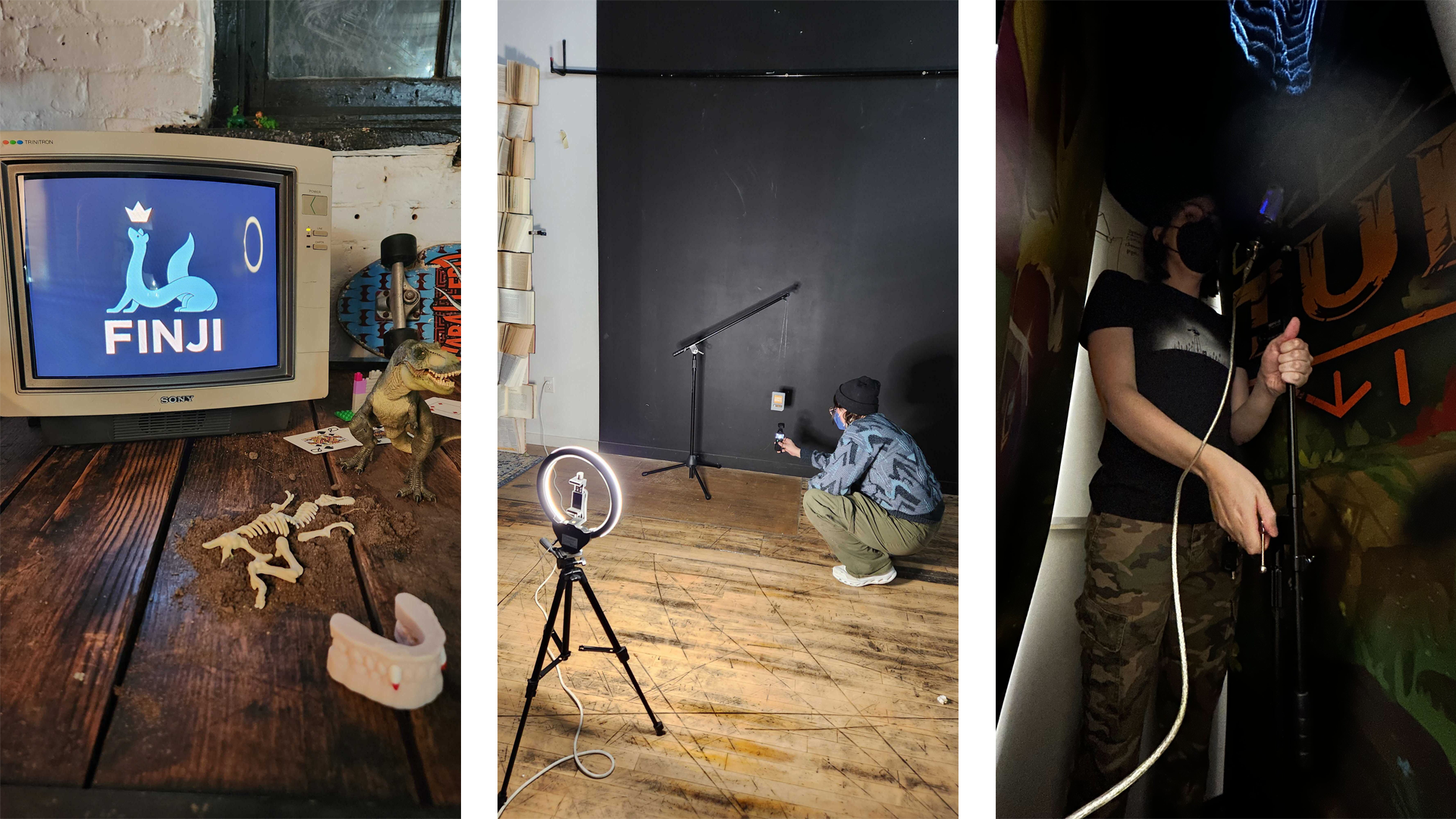
Finji Behind the Scenes - Making the CorgiSpace Trailer
Creating the launch trailer for CorgiSpace was a studio-wide effort! We worked together to create and collect props, write scripts, record voiceover, and more, and we had a lot of fun doing it!
We talked to some of the team to learn more about the process of bringing the CorgiSpace trailer to life, and we’ve got some behind-the-scenes photos to share!
Marketing Lead Emily Liles had a lot of fun putting a team together for the trailer.
When I sheepishly asked Adam if he thought making a trailer in the style of an early 90’s video game commercial was a good fit for CorgiSpace, I never imagined he would actually say yes! But he did, and our team at Finji pulled together with some amazing stuff for it. Taylor Normington, QA, and I worked together on a goofy script. We were both surprised how easy writing it came to us. For years, we’ve joked around about Senior QA Analyst Gwen having a great voice for voiceover. We were able to put that theory to the test with the VO in the trailer, and Gwen knocked it out of the park! Taylor, Gwen, and I set up a makeshift sound booth with convention signs in the Finji office, and we had a really fun time recording those lines together! I’m so proud of our team. We all used our talents to make an incredibly indulgent and fun trailer, and we had fun doing it! My only regret is that we didn’t use the smoke machine enough because I was scared it would set off the fire alarm at the studio.
If you look closely at the trailer, you’ll notice an array of objects, from toy dinosaurs to crocheted pugs. Taylor found that part of the process particularly fun.
Scrounging together the various objects used in the trailer to represent the game collection was fun and even though the skull setting inside of gelatin did not pan out, I think the shots of that gooey mess jiggling on that plate turned out all the better for it!
And, when asked about her incredible VO work, Gwen said
They told me ‘monster truck voice’ and I said ‘ok.’
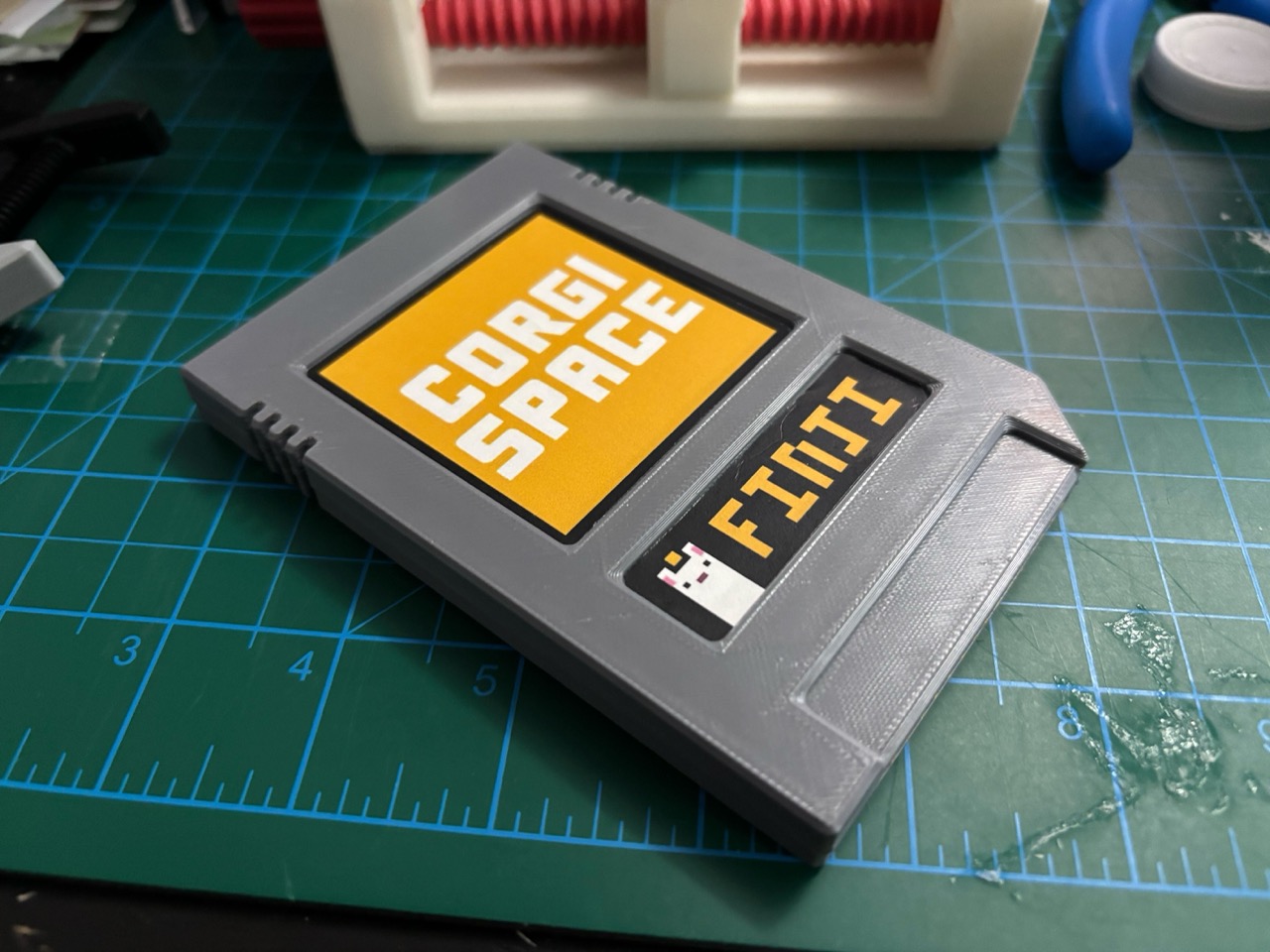
The star of the trailer was the CorgiSpace cartridge, 3D-printed by Jonah Davidson from the QA team
I was excited to make a cartridge, but pretty quickly I realized certain details needed to feel right. I’ve tinkered with 3D modelling before, so making the cartridge wasn’t too hard. I looked over a lot of cartridge design references, but ultimately wanted to make something like the digital Pico-8 cartridge images that each game generates. I hit on some fun ideas very quickly, like using green and gold filaments to print a circuit-board-esque piece that would slot inside for that extra touch of realism. The real tricky part was ‘slicing’ the model, the process of prepping it for 3D printing. I had to completely redo the print design three times. Each used different materials, and I sliced up the model into a different number of pieces, trying to find a balance. I had to carefully choose which side of each piece would be printed face-down, which gives that face a rough texture. The first printed version was too smooth and too simple, and the second had some messy details and less-than-perfect fits. But without making both of them, I wouldn’t have gotten to the third, which I think is the perfect balance. I’m pretty proud of it, especially as someone just experimenting with models and prints. Industrial/product design is hard, and I’ve got more respect for it than ever.