June 2026 Newsletter
You can sign up for the newsletter here!
Usual June Dev Update: Designing the weirder places
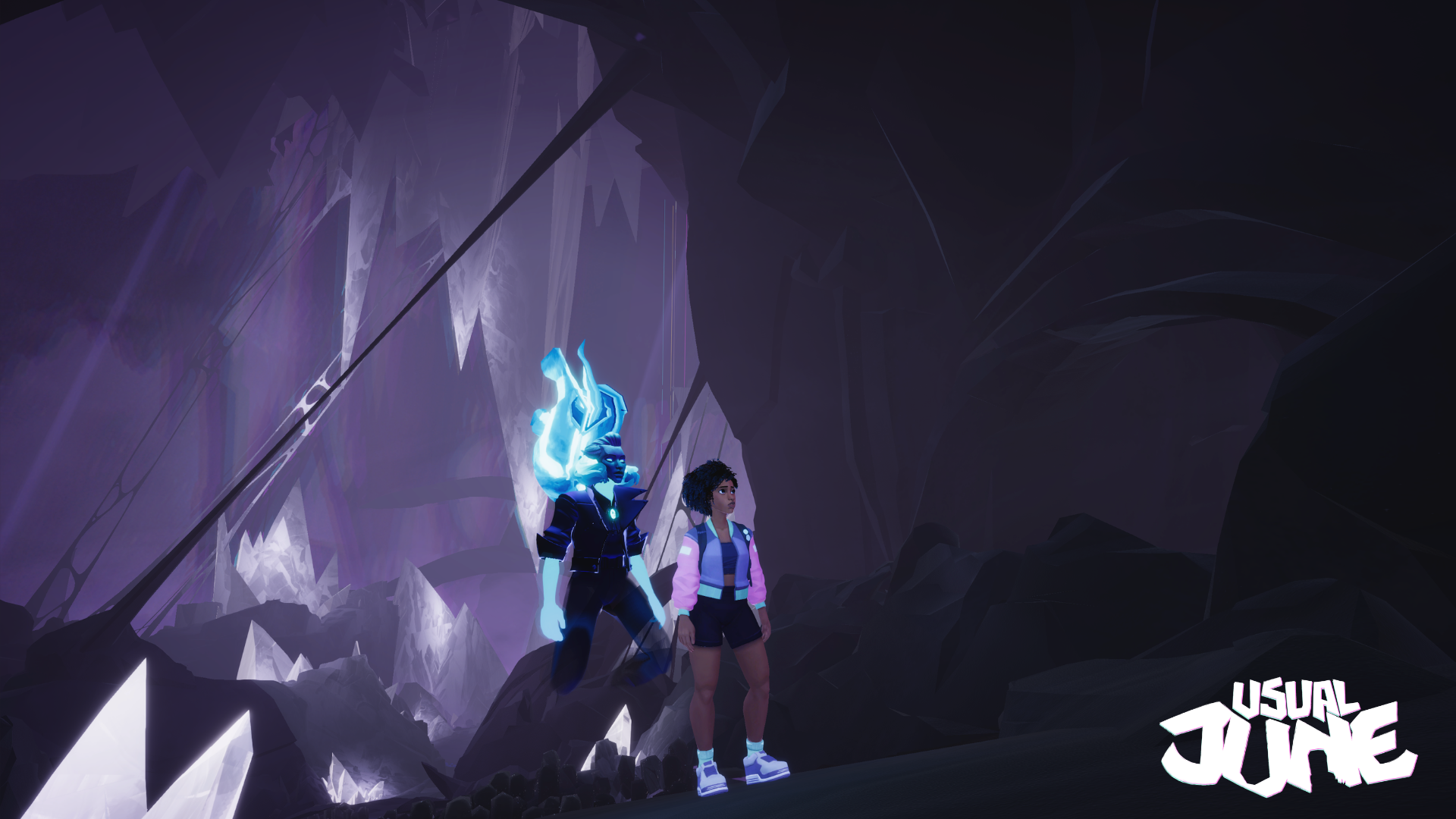
Some of you may have seen the, well, weirder areas of Usual June in our early demo, but the team has been working on them a lot since then! Part of that work was bringing on the incredibly talented Concept and 3D Environmental Artist Beatriz de Abreu. Social Media and Community Director Aster Wright had a chat with Bea about her work on Usual June.
ASTER: Since joining Finji, you’ve been working on both concept art and level design for the weirder areas of Usual June. Can you talk about what first drew you to the project and how your work has evolved since your earliest sketches?
BEA: On a personal level, I always wanted to work with an indie studio. Most of my past work was in AAA, but I mostly play indie games these days, and have worked on little indie projects and game jams in my free time. I was also always a big fan of Finji’s games as well, so being able to contribute to a Finji project was super exciting.
The setting for the game also seemed very fun, and being allowed to do a lot of weird experimental art is always very nice. I like that the project doesn’t quite fit neatly into the general aesthetics of sci-fi or fantasy. I think with concept art, everything is kind of changing all the time, and a big part of the process is making images to see what sticks, which ideas are most evocative and then leaning into those. You’re sometimes just making images until something just feels right, and you try to make everything else fit into that vision. Then, the next big challenge is making sure you retain that vision as much as possible on the way to the final product, which is probably the hardest part and where I see a lot of projects lose their vibe. The nice (and scary) thing about doing both concept and 3D is that I can be in charge of both sections of that process for the maps that I make.
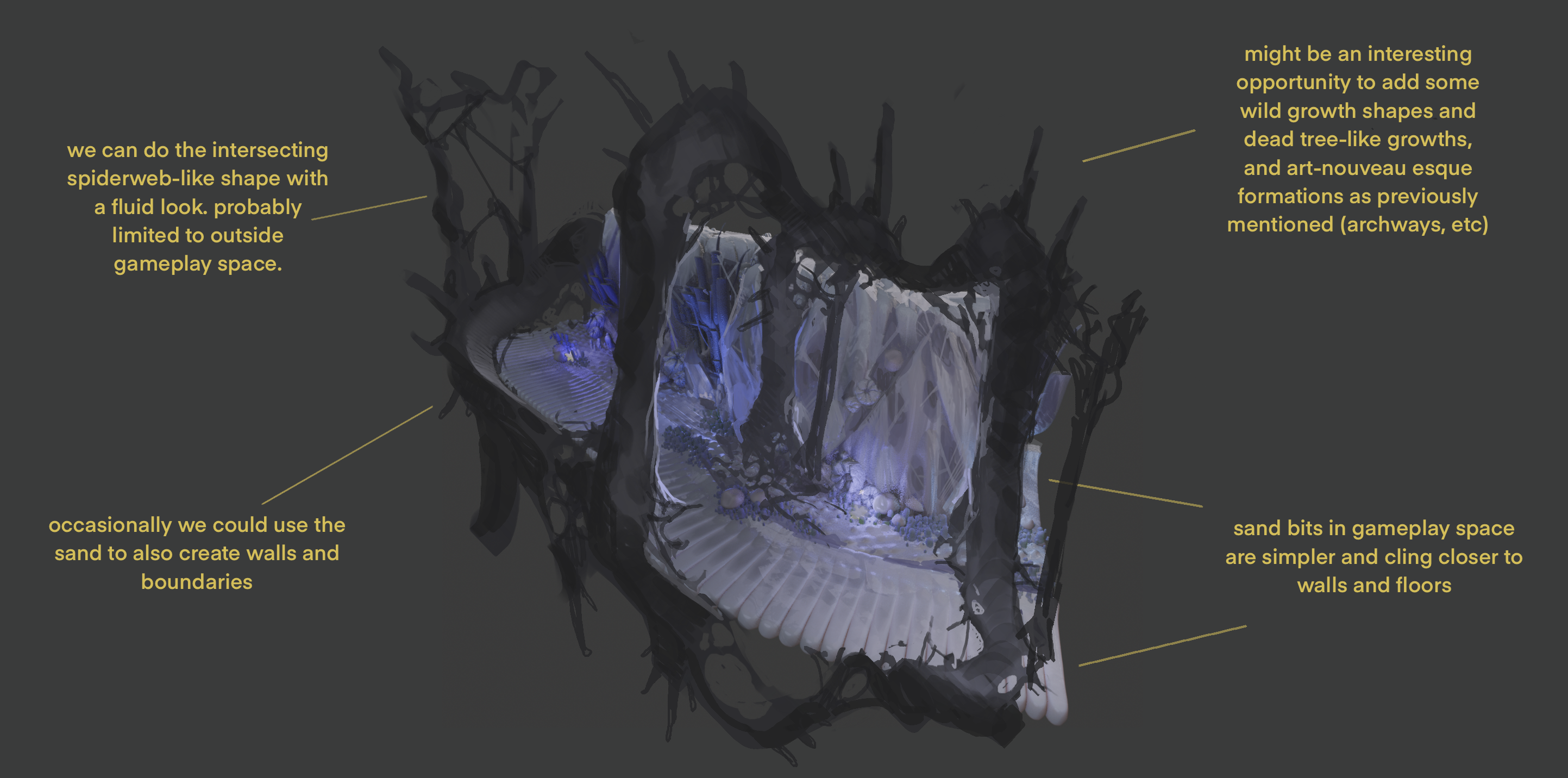
ASTER: I know I speak for everyone when I say we can’t wait to explore these beautiful and eerie spaces you’ve been building. From where have you been drawing inspiration? What goes through your head as you’re designing this kind of place?
BEA: There was a big internal idea for not drawing from direct references in general - these areas are meant to feel eerie and outerworldly (but not actually like an alien planet), alive and lush but intentionally avoiding any real world foliage. This led me to draw from references that are not really directly related to what I’m doing.
For instance, if I’m designing something that roughly has the shape and size of a “weird plant,” instead of looking up weird plants, I’ll look at deep sea creatures, amoebas, mushrooms, jellyfish, close up images of bacteria, etc. Sometimes just interesting patterns that don’t really map to anything specific in nature. For some of the maps, I was looking at these fine art installations of black tar dipping down on surfaces, weird stuff like that. I found that tends to create more interesting and strange results than drawing from “literal” reference, while still feeling natural and not like you’re doing weird things for the sake of being weird. I’ve also drawn inspiration from other projects too, though. I think some major ones are Jusant, Scavenger’s Reign, and Nausicaä.
ASTER: What has your creative process been like? Have you run into any challenges?
BEA: When it comes to early exploratory paintings, my process has always been very chaotic. I don’t exactly know what a painting will look like when I start it, and there’s a lot of natural exploration involved, it’s a very gestural process of letting my personal taste guide me, and finding specific shapes and colors and moments in the chaos that seem interesting and unique.
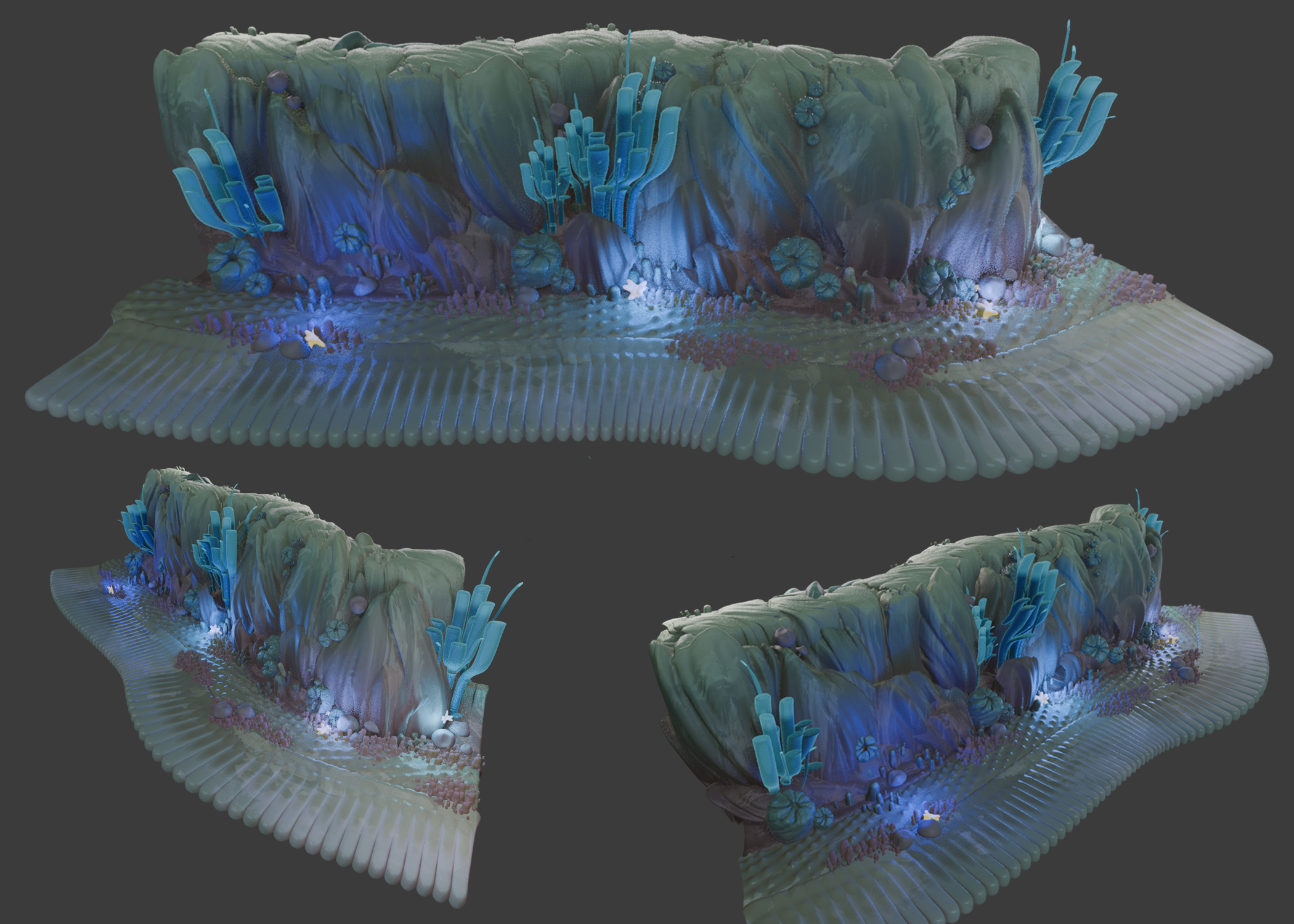
After I have a general idea of what I’m going for in an area, I get increasingly more specific, designing individual props or painting what a single walkway or room in the game might look like. At this point I’m essentially making visual mockups of how I want the final game to look.
I think the most difficult part is translating the specific vibes my paintings have into designs that can be turned into 3d spaces you can walk around and play in. It’s super difficult, and takes a lot of creative problem-solving to achieve that look in a way that is still walkable, performant, and visually clear to the player. Coming up with an aesthetic that is unique is hard, but translating that to a game, without compromising what made it interesting in the first place, is even harder.
What are you most excited to see in Usual June? Let us know in the Finji Discord and we just might do an Dev Update on it!
Wishlist Usual June!
An Interview with 868-BACK Developer Michael Brough
Just a month after the release of 868-BACK, Social Media and Community Director Aster Wright talked with Developer Michael Brough about everything from Michael’s journey back to making games with 868-BACK, what inspires him as a game designer, why he wanted to make a game about hacking, what he’s most proud of in 868-BACK, and so much more.
ASTER: 868-BACK is out now! You talked in a recent newsletter about your motivation for making a sequel to 868-HACK. Can you tell us about the journey of developing 868-BACK?
MICHAEL: Since 2020 I have been affected by chronic fatigue / long covid. For the first couple of years this was severely disabling. It was unclear whether I would ever be able to work again. Through 2021, I gradually recovered limited physical capacity, but attempting anything that required mental concentration left me instantly exhausted. I gathered wild plants to feed my family. In late 2022, I opened a Patreon asking for support to try to work on games a bit again. My wife’s job had finished and we’d used up our limited savings. I still couldn’t work consistently. I started a video series talking about my work. I ported one of my older games to Godot engine so I could release it on more platforms. I made a few prototypes that went nowhere. I pottered about. I spent a lot of time thinking about the factors that had supported a fruitful creative practice in the past, and how to reintegrate those into my life in a way that made sense in the present.
I wasn’t sure if I really wanted to come back to making games long-term. I had made a bunch of good games which were highly regarded by people who knew about them, and that gave me absolutely no financial security. Maybe that’s enough of my life spent on that? But it was something I could do by myself at my own pace, so it made sense to try.
I found something that I felt was important to do. My game Cinco Paus had not reached many people and I wanted to find a way to change that. Considering the options I concluded that making a full sequel was the best way to make that happen. I announced that in early 2023, and was quickly thrown off track because I was offered funding for it, which somehow instead became much less funding for another game, which was then cancelled. That’s the game industry. In the aftermath of that I wasn’t emotionally ready to continue working on either of those projects, but by then I was fully back into the flow of making games so I cast about for what else to make and hit on 868-BACK: a completely different sequel.
In my preliminary work on the Cinco Paus sequel, I’d developed my ideas on how to approach sequels in general. I wrote in 2024 “The concept of a sequel is valuable to the extent that it frees you. You can reuse work that you’ve done before, mechanics that you understand well, without any pressure to be ‘original’ - that’s freeing! If you get trapped trying to hold true to the original, that limits you, forget it. The original still exists, a sequel doesn’t overwrite it, and it’s great if some players like the original better - comparing different entries in a series is gameplay.” I mostly still stand by that - except that now I have more acceptance of the possibility that a sequel could be allowed to be unambiguously a better game.
I crowdfunded 868-BACK later that year, for a modest budget and what turned out to be an overly ambitious timeline! It’s the biggest game I’ve made and I severely underestimated how long it would take to get all the possible interactions to work together. (One might expect sequels to take less time, but often they need more because the low-hanging fruit got eaten the first time around.) Possibly, I should have set a higher minimum target for the crowdfunding, but as I’d already been depending on donations for two years I was a bit worried I’d be asking too much of people.
I kept working away at it and in the end Finji picked it up and supported us through the last several months of development, as well as helping a ton with finding ways to make the game more approachable without compromising the heart of it, and supporting collaborations with AJ and Josie on some of the graphics and sound. (Thanks Finji!)
It might seem counterintuitive that I made such a big game while I’m unwell and less capable of working, especially since I’m mostly known for making lots of small games. I can’t explain it, but that’s how it’s worked out. The smaller games I tried to make weren’t coming together, and somehow the momentum of working at a more ambitious scale helped carry me along. A few times I started to show more serious symptoms again and we had to organise things so that I could take a small break. We’ve developed good strategies for managing my condition.
Towards the end I managed to ramp up to working at quite a high intensity, and it felt amazing to be able to do that after not being sure I could ever even work at all again. My health is a lot better than it was six years ago, but still I definitely can’t sustain that for very long. I only felt safe to work so hard by trusting that I could rest for a while afterwards. That’s what I’m doing now. There are still things to do - bugs to fix, ports to port - and I’m getting to them, but I’ve slowed down a lot. I’m quite tired. ASTER: What inspires you as a game designer?
MICHAEL: Anything and everything! Often there’s a sensation I’m interested in, an experience I’ve had, a shape I’ve encountered in the world, a relationship between things or ideas. Following that interest guides me to the work, but usually in a quite transformed way such that nobody else is ever going to be able to recognise how that was my starting point. I made a game inspired by the experience of walking through a crowded street market; a game inspired by a fevered vision while suffering from food poisoning; a game inspired by climbing in a ruined castle looking out over the sea. The reader may attempt to guess which of my games these are.
Also often there’s an element in another game that inspires me; something I want to boil down to its raw elements and then build back up to make my own version. Obviously I’ve taken a lot from Rogue and roguelikes, but also plenty of other games - especially Race for the Galaxy, DOTA, and SpaceChem. It’s probably important to have this balance of drawing inspiration from both inside and outside of the medium.
Having a maths degree helps too: it’s a toolkit of concepts that turn out to be very relevant throughout game design and development.
ASTER: Can you talk more about the world building you’ve done in 868-BACK?
MICHAEL: I don’t like too many words in a game. If I want a story I’ll read a paper book: that’s just more comfortable for me. I read a lot of books, it’s just not what I’m usually looking for when I play a game. (I’ll make exceptions, of course - I like Planescape: Torment as much as the next guy, I get on well with Christine Love’s games, and I am definitely going to try that I Was a Teenage Exocolonist game that Adam and Bekah keep mentioning…)
When I’m making a game, I feel like there’s an underlying fictional reality I’m tapping into. The game has a setting, a world, a story - whether I tell it or not. I love the style of narrative that videogames had in the 80s and early 90s, where the plot and setting is communicated through incidental text like level titles and enemy names. That’s the approach I’ve mostly tried to take - hinting at the idea of a world through sparse splashes of text, as well as simply letting it show through in the design. A few people have appreciated this but more often they were finding my games austere and abstract. I realised that if I wanted to connect with more people I’m going to have to somehow go further.
It wouldn’t work to go against my style. Other ways of storytelling in games aren’t wrong, but for me to do it well myself I have to find an approach that harmonises with my work. Importantly, I’m not trying to make up a world - I don’t know how - but to communicate the underlying world that I feel is in some sense already there. I’m trying to amplify this subtle presence so more people can access it.
Of course it helps if I find out more about this world! I can ask questions and, assuming the world “exists” maybe I can discover the answers. Clues could be anywhere - in the original game, through the development progress, in the contributions from my collaborators. If one of the programs works differently in the sequel from the original: who changed it, and why? If the player has multiple lives now, where they didn’t before, what technology is enabling that?
As I looked, I found answers to these kinds of questions, and ways of expanding the “arcade” storytelling style. 868-BACK has pop-up advertisements that tell you all about the very wonderful and good things that the megacorps can sell you. It has lots of weird names and descriptions and instructions and songs and decorations that all add little pieces to the story.
Like every fictional world, the game draws from reality. Talking about hackers automatically makes us think of cyberpunk tropes - abusive megacorporations, technology as a tool for oppression (or liberation!). There’s been a lot of this in the news. Every day we hear of new unimaginable horrors. Putting these into art is a constructive way of processing them. Art is political: we’re literally creating culture. The patterns we cast will ripple out through thoughts and actions and into the world.
When you start thinking about the real-world implications it can feel like it’s important to Get It Right. You want to make sure your politics are correct. But we can’t know for sure; the world is so damn complicated and even well-intended policies can backfire. As game designers we see this all the time up close: the rules we make up to get a certain effect don’t work, sometimes they create the opposite effect, and we just have to try again. I don’t know the answers! This needle is threaded by grounding the work in personal experience. The same company can be wreaking destruction at an epic scale and also putting annoying ads on my phone. It can feel trivial to complain about this minor annoyance when the big horrible thing is happening, but they’re two ends of the same beast, and the personal connection is the lever that lets the art reach into it. Personal experience is independent of whether your ideas are right or wrong: it’s just what happened, and you can tell about it. For me, that takes the pressure off.
ASTER: Why did you want to make a game about hacking?
MICHAEL: Hacking is about breaking the rules. Hacking is about revealing the truth. There’s a gap between what a system is supposedly meant to do and what it actually does. If you find that gap and wedge into it, you’re not breaking the system: you’re simply exposing its reality.
These motivations just line up perfectly with games. Games are made out of rules. When we play we try to find the holes in the rules - the places where the system wasn’t perfectly designed - where we can get an edge. When we play we seek truth.
To play 868-BACK well you need to enter this hacker mindset. Look for ways to bend the rules. Don’t do what you’re told. This is one of the points we see some players struggle with, especially younger gamers who might be more accustomed to games that tell them directly what to do and don’t offer options that they’re not equipped to handle yet. I wouldn’t say the game is “old-school” overall - some aspects of the design are sharply modern - but this particular aspect is definitely informed by my childhood experiences with games. A game isn’t a product to be consumed: it’s a mysterious portal that might take you somewhere wondrous if you can find the way in.
ASTER: What are you most proud of with 868-BACK?
MICHAEL: I think I’ve done a damn good job of making the rules and mechanics of the game support the themes and worldbuilding. One of my favourite pieces is the Mega-AI bonus powerup, which represents the feeling of being trapped on an “optimal” path of productivity. This concept came first, and I went through a ton of versions to find a ruleset for it that actually worked. It had to restrict the player enough to feel oppressive, without going too far and making it actually impossible - a very fine line. Being able to scrub back and on the path was the insight that made it come together. And then I had to find the right interactions with everything else that could affect it - other ways of moving around, effects that trigger from or prevent damage. What I ended up with is completely new: I’ve seen nothing like it in any other game. ASTER: You design games in a way that rewards curiosity. Why is that important to you?
MICHAEL: I try to make my games work for a wide range of players by putting goals that are satisfying to uncover at all kinds of levels. A mountain range with multiple peaks. The first hills - like completing one server - are still real achievements when you start out! Then you can string together wins, survive for a week, two weeks, hack a megacorp, hack The Mainframe, and go on and on into harder challenges and high-score goals to the point where it’s as challenging as anyone could possibly want. Some players go incredibly deep. Not everyone has to.
One of the core principles of 868-HACK was that it’s “easy” to just get to the end empty-handed and you increase your difficulty level on the fly by stealing more data. (Easy isn’t obvious; there’s still some things to learn and explore to get to that point.) With 868-BACK putting a clearer focus on the campaign of hacking multiple servers in a row, I wanted to make sure this was also in some sense “easy”. You can avoid the megacorps entirely - or go straight for them. One character in the game advises you one way while another says the opposite: when you receive conflicting advice you know you have to choose for yourself.
ASTER: What are your hopes for players experiencing 868-BACK for the first time?
MICHAEL: Have fun for yourself! Don’t compare yourself too much to other people - the leaderboard is labeled as a cognitive hazard for a reason. Play at the level you’re at, and discover a little bit more each time.